
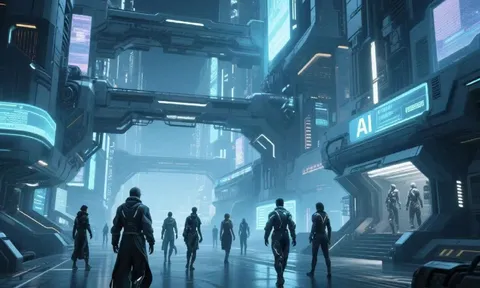
What sparks can “AIGC + mini-dramas” generate? What are the potential applications, and what challenges do they face? These questions have become a major focus
within the industry.
“Currently, some AI-generated short dramas have fallen into the quagmire of anti-intellectualism. Their absurd plots and chaotic logic are simply staggering. The
proliferation of such content has dealt a devastating blow to the cultural ecosystem of AI short dramas themselves,
” one expert pointed out sharply.
The film and television industry is undergoing a profound transformation driven by AIGC technology. The wave of AIGC is rapidly spreading across the mini-drama
sector.
“AIGC + Mini-Dramas” Enters a New Phase of Expansion
Since last year, the AIGC wave has swept across the globe. Reports show that the usage time of AIGC applications surged by 393.9% year-on-year, making it a new
growth engine, with total short video viewing time reaching 8.65 billion hours. Meanwhile, innovative applications like AI search have emerged as dark horses in the
first half of the year.
Similarly, mini-dramas have flourished due to their low investment, quick returns, and high cost-effectiveness. Data indicates that as of December 2024, mini-drama
users reached 662 million, with a market size of RMB 50.44 billion, establishing them as a new content consumption trend.
With both AIGC and mini-dramas gaining momentum, the new format of AI mini-dramas is bringing more innovation and possibilities to the market. The audiovisual
sector is accelerating in this field.
ByteDance’s AI creation and content platform, Dreamina AI, in collaboration with Douyin, launched the “AIGC Short Drama Co-Recruitment Program.
” The initiative
provides comprehensive technical and platform support for short drama production teams through investment, co-operation, and incentive activities.
Kuaishou has introduced programs such as the “Starlight Short Drama × Kolin AI Creator Incubation Plan” and the “Star Wit” AI Short Drama Creation Competition,
offering support including platform investment and revenue sharing.
Hongguo Short Drama released the first industrial-grade AI short drama, "Fantasy: It All Starts with the Erhu"; Bona Film Group produced the AIGC sci-fi series "Sanxingdui: Apocalypse of the Future"; Kuaishou and Kolin AI jointly released the AI unit drama "New Century Loading"...
It is evident that mini-dramas, as a flexible and creative content form, are poised to become a pioneering field for new technologies like AIGC and virtual production.
With continuous technological advancements, AI mini-dramas demonstrate enormous potential and limitless possibilities.
- Weak IP Attributes Hinder Commercialization
Experts note that building a sound business model and achieving sustainable development for AI short dramas require multifaceted efforts and exploration.
Currently, AI short dramas face numerous constraints in achieving commercialization.
From a technical perspective, AIGC technology primarily relies on data learning and imitation, making it difficult to generate truly original plots and characters.
Although AI virtual characters can simulate human language and behavior, they struggle to capture the depth of complex emotions such as humor and fear.
Additionally, issues like character inconsistency and scene incoherence frequently disrupt immersion, making it hard for audiences to connect with the story.
Industry practitioners also point out current shortcomings in AI short dramas:
Character consistency
Scene coherence
Character performance
Action interaction
For example, a character might wear thin-rimmed red glasses in one shot but thick-rimmed glasses in the next.
Guiding AI to better understand human creative intentions and integrate emotions and thoughts into generated content remains a key technical challenge.
In terms of content creation, AI short dramas are highly concentrated in themes, currently dominated by “sci-fi, fantasy, and magic.”
On one hand, public awareness of AI short dramas is still in its infancy, significantly hindering their popularization. This awareness gap creates barriers to information flow during
market promotion.
On the other hand, traditional film and drama production has established mature processes and aesthetic standards. Audiences have high expectations for plot coherence,
character development, and emotional expression. Due to technical limitations and creative differences, AI short dramas often fall short of these standards in the short term.
Although the concept of AI short dramas is novel, they have not yet “broken through” as expected to become a new favorite in mass cultural consumption.
Most AI short dramas lack strong IP attributes and fail to sustain influence, resulting in low viewer retention and limited willingness to repurchase or rewatch.
In terms of business models, profitability is the cornerstone of any industry’s sustainable development. The sustainable growth of AI short dramas relies on a mature and
innovative business model, which involves not only financial returns but also building a win-win ecosystem for all stakeholders.
Currently, the revenue models for AI short dramas resemble those of traditional short dramas, primarily relying on advertising income, copyright sales, and platform revenue
sharing. Due to the lack of a broad user base and market influence, these traditional models are insufficient to support long-term development.
In summary, AI short dramas are still immature in terms of business models, lacking sustainable profitability paths. Beyond exploring diversified revenue models such as
memberships, pay-per-view, and derivative development, they should strengthen cooperation across the industry chain to form a healthy ecological cycle.
In my view, AI short dramas can achieve deeper integration with various industries—such as education, tourism, fashion, and e-commerce—through cross-sector
collaborations. This will expand the boundaries of content creation, inject new vitality and creativity into traditional industries, and greatly enrich the application scenarios
of AI short dramas, positioning them as a bridge connecting multiple sectors.
- Challenges Facing AI Mini-Dramas
The integration of AIGC technology is poised to reshape the ecosystem of the mini-drama industry, bringing new development opportunities. However, amidst this fervor, we
must remain cautious of the many existing issues.
Some AI mini-dramas over rely on technology and special effects, prioritizing visual splendor and smooth action at the expense of plot coherence and character
development. Such works often resemble flashy slide shows.
Others focus excessively on superficial visual presentation, neglecting the values and humanistic care that should be conveyed, leaving audiences without profound
insights or reflections.
Some pursue short-term clicks and attention rather than long-term reputation and influence. With a flood of AI mini-dramas entering the market, many producers sacrifice
quality for quick profits.
Certain AI mini-dramas have sunk into “anti-intellectualism,
” with absurd plots and illogical narratives. The proliferation of such content has severely damaged the cultural
ecosystem of the AI short drama industry.
Additionally, AI short dramas face challenges in content updates, technological iteration, and copyright protection. How can they ensure continuous content innovation to
adapt to market changes? How can they keep pace with technological advancements to improve quality and competitiveness? How can they effectively protect copyrights
and safeguard creators’ rights? These are critical questions that must be addressed for sustainable development.
Human creativity is a complex product of life experiences, emotional depth, and aesthetic pursuit—unique and irreplaceable. In contrast, AI-generated content is based on
data and algorithmic simulation, often leading to stereotyping and homogenization.
Creators must recognize that short dramas should not become shallow showcases of AI technology nor breeding grounds for speculative hype. To avoid homogenized and
low-quality AI short dramas trapped in a vicious cycle, it is essential to resist blindly chasing trends at the cost of content quality.
Whether “AIGC + mini-dramas” can become the next big trend depends on how organically they are integrated to create content that is both innovative and valuable—a
question deserving in-depth reflection.
In my opinion, for AI to play a greater role in the mini-drama field, the key lies in merging the two organically to produce creative and practically meaningful content.
For AI short dramas to truly “break through” and become a staple of mass cultural consumption, more efforts are needed to enhance public awareness, improve content
quality, strengthen market competitiveness, and refine relevant policies and regulations.